
Color Name Finder
Give any hex a name you can say out loud.
Last updated: November 1, 2026
Pick a color
From anywhere on your screen, straight out of an image, or by typing any CSS color.
Or start from the current color
Color inspector
Every notation at once — click any row to copy it.
#DC2626
Medium vivid warm red
Best text on this fill
#FFFFFF · 4.83:1
Dark fill — white or a light tint carries body copy here.
Copy it as
tap a box to copyEverything in this picker — tap to open
Is it readable? (WCAG 2.2)
Ratio, pass/fail for every threshold, and a fix that changes only lightness so the hue stays yours.
Text
Background
Ratio
4.83:1
ΔL* 52.1 · ΔL(ok) 42.3
The quick brown fox jumps over 13 lazy dogs.
Body copy at 13px — this is the size most interface text ships at, so the AA threshold is the one that matters.
- Body text · AA≥4.5:1
- Body text · AAA≥7:1
- Large text · AA≥3:1
- Large text · AAA≥4.5:1
- UI & icons · AA≥3:1
Passes AA for body text. Readable from about 14px upward, any weight. APCA — the perceptual model proposed for WCAG 3 — is not a legal requirement yet, and rules like the EU Accessibility Act reference WCAG 2.x, so this tool scores against WCAG 2.2 and reports the perceptual lightness gap alongside it.
Everything runs locally: the eyedropper uses your browser's own EyeDropper API, image sampling reads a canvas buffer in this tab, and nothing is uploaded, watermarked or logged.
Quick answer
Paste a hex — or pick the color on screen or in an image — and the tool reports the nearest of the 148 CSS named colors by CIEDE2000 distance (for example #F36A1D is closest to chocolate, at ΔE ≈ 4), plus a plain-language descriptor built from OKLCH lightness, chroma and hue: medium warm orange, very light muted blue.
About this tool
Naming a color is a measurement problem dressed as a vocabulary problem. There are only 148 names CSS defines, and matching a hex to the nearest one requires a perceptual metric — RGB distance puts dark reds next to browns that look nothing alike, while CIEDE2000 in Lab space matches how people judge colors. This finder does that and reports the distance, so you can tell whether a match is honest (ΔE under 5) or a stretch (ΔE over 20). The descriptor adds the lightness band, warmth and chroma word designers actually use in specs, which is usually what someone wants when they ask what a color is called.
How it works
Three steps, about a minute, no account.
Get the hex
Paste a code, or sample the color from your screen or a photo.
Read the match
Nearest CSS name, its hex, and the perceptual distance between them.
Copy what you need
The descriptor for a spec, or the name token for CSS.
Why this version is different
148 CSS Names
The full named-color set from CSS Color Level 4/5, plus -grey spellings.
Honest Distance
ΔE2000 shown, so you know if the match is real or approximate.
Plain-Language Label
Lightness band, warmth, chroma word and hue family.
Sample to Name
Name the color from a screen pick or an image pixel, not only a paste.
Reverse Lookup
Type teal or rebeccapurple and get its hex and all notations.
Frequently asked questions
How many named colors does CSS have?
148 in CSS Color Level 4 and 5, including both gray and grey spellings. They map to fixed sRGB hex values, which is why they are useful as reference anchors.
Why is the nearest name sometimes a poor fit?
Because the named set is sparse and unevenly spread — there are many blues and few cyans. The ΔE figure tells you how far off it is: under 5 looks the same, over 20 is a different color.
Is there an official name for arbitrary colors?
No universal registry exists. Projects with 300-1000 name lists exist for designers, but they are not standards, so this tool sticks to the CSS set and a measurable descriptor.
Can I use the names in code?
Yes — named colors are valid CSS. Prefer hex or oklch() for production tokens; names are best for conversation, documentation and handoff.
Want the whole workspace instead of this one panel? The full online color picker adds harmonies, tonal scales, extraction, gradients, the mixer and color-blindness checks.
More color tools
Twelve focused versions of the same picker — each one opens on the panel you came for.
More IMAGE Tools
Explore other helpful tools for your workflow
Related Articles
View all articles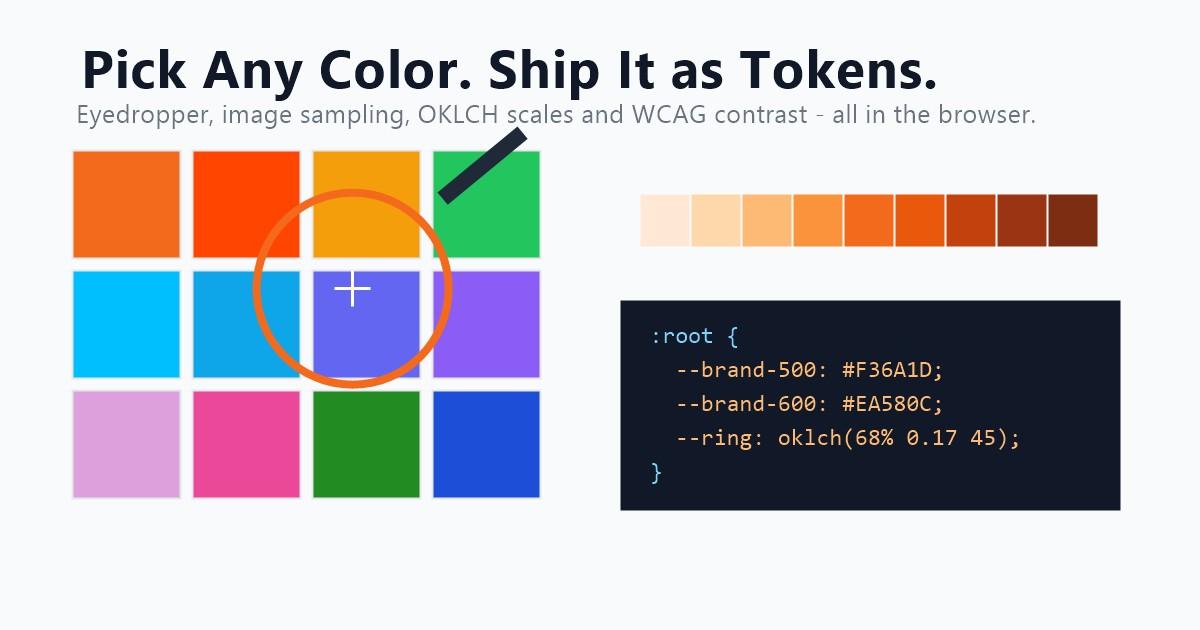
How to Pick a Color from an Image (and Ship It)
Sample the exact pixel from a photo, logo or screenshot, then turn it into HEX, RGB, OKLCH, a 50-950 scale and WCAG-safe design tokens.

Rename Multiple Files Online Free – Guide
Rename hundreds of files in seconds. Add prefixes, numbering, dates, and patterns – all online for free.